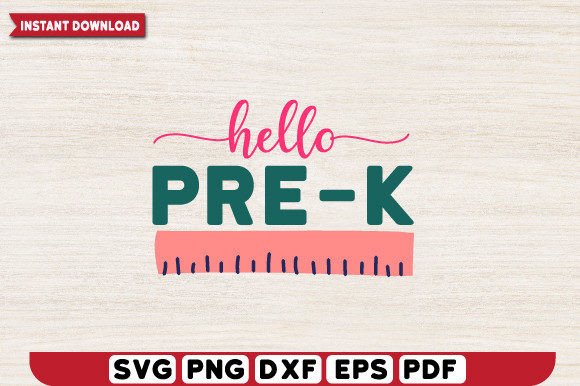
Hello Pre-k Svg Design: A Crafter’s Stitch Review
As a professional embroidery designer and product reviewer, I approach every new digital asset with a critical eye. When evaluating the Hello Pre-k Svg Design, my first thought isn't just about how cute it looks on a screen, but how it will translate into thread on fabric. This back-to-school graphic carries a distinct mood of youthful excitement and milestone celebration. Visually, it strikes a balance between playful typography and clean lines, which is exactly what we look for in Crafts and Graphics intended for children's apparel. However, moving from a vector cutting file to a stitched reality requires careful consideration of structure, density, and end-use application.
First Impressions and Visual Personality
The immediate appeal of this design lies in its versatility. It feels nostalgic yet modern, making it an excellent candidate for a wide demographic ranging from toddlers to parents documenting milestones. As a machine embroidery design foundation, the layout suggests strong potential for both standalone center chest placements and smaller pocket-sized motifs. The shape implies a friendly, approachable aesthetic that avoids being overly juvenile, allowing it to age well across different grade levels or serve as a keepsake item.
For an Etsy seller or small shop product creator, this visual personality is crucial. Customers aren't just buying a shirt; they are buying the feeling of preparedness and pride associated with starting school. The design’s composition needs to hold up when scaled. In my review process, I always assess whether the negative space is sufficient to prevent the design from looking muddy once converted to stitches. This particular style lends itself beautifully to mixed media techniques, where the bold shapes can be executed as an applique design while finer details remain as running or satin stitches.
Real-World Application: The Custom Sweatshirt Test
To truly judge the viability of the Hello Pre-k Svg Design, I mentally placed it in a real-life production scenario: creating a custom crewneck sweatshirt for a boutique fall collection. Sweatshirts are a staple for custom apparel, but the fleece backing and knit structure present specific challenges. In this scenario, the design serves as the focal point of a personalized gift or a ready-to-wear retail item.
When stitching this onto French terry or heavy cotton fleece, the primary concern is stabilization. A design with this level of thematic importance cannot afford to pucker. I would recommend using a medium-weight cutaway stabilizer to support the stitch density required for crisp lettering. If utilizing this as a sweatshirt embroidery project, consider how the design interacts with the garment's seams and ribbing. Centering is paramount; even a millimeter off can make a handmade product look amateurish. Furthermore, if you are adapting this SVG for embroidery software, ensure that the fill areas have appropriate underlay to prevent the fabric texture from showing through the threads, which maintains that professional, high-value appearance customers expect.
Navigating Fabric Limitations and Hoop Constraints
While the design is versatile, it demands respect for material limitations. Not every fabric is suitable for detailed back to school graphics. Here is where practical judgment comes into play:
- Stretchy Fabrics: When applying this to baby onesies or lightweight tees, the tension can distort the design. Always use a fusible poly-mesh stabilizer and consider a water-soluble topping to keep stitches from sinking into the knit.
- Textured Surfaces: On terry cloth towels or plush blankets, fine details in the Hello Pre-k Svg Design may get lost. You may need to simplify the file or increase column widths to ensure readability.
- Small Hoop Sizes: If you are working with a 4x4 hoop, scaling down is inevitable. Be wary of tiny serifs or thin connecting lines. Below a certain size, these must be converted to simple running stitch outlines or removed entirely to prevent needle breaks and thread nests.
- Curved Surfaces: For caps or sleeves, the flat geometry of an SVG must be warped or arced to match the curve. Without this adjustment, the design will appear distorted on the finished embroidered patch or hat.
Understanding these constraints prevents wasted materials and ensures your commercial embroidery output remains consistent, whether you are making one baby embroidery bib or fifty matching shirts for a classroom.
Impact on Product Value and Brand Trust
In the competitive world of digital product sellers and apparel decorators, technical execution defines brand reputation. A poorly digitized version of the Hello Pre-k Svg Design can lead to pull compensation issues, where letters separate from their borders after washing. This directly impacts customer trust. Conversely, a well-executed stitch-out elevates the perceived value of the item.
Visual clarity drives buyer engagement. When listing items online, your printable mockup should accurately represent the stitch texture. Don't just show a flat digital image; show a photo of the actual finished product. Buyers want to see how the thread colors interact with the fabric. Does the white text pop against a navy sweatshirt? Is the contrast sufficient for readability in low-light photos? These factors influence conversion rates for Etsy listings and craft business sales. Professionalism isn't just about the art; it's about proving that the art survives the manufacturing process.
Essential Designer Notes for Successful Execution
Before you load this design into your machine or list it in your shop, run through this practical checklist. Since the product description identifies this primarily as a cutting file compatible with Cricut and Silhouette, verifying its suitability for embroidery is your responsibility as the maker.
- Verify File Compatibility: Confirm you have a proper embroidery file format (PES, DST, JEF, etc.) or a digitizing-ready vector. Do not assume an SVG auto-converts perfectly to stitches without manual cleanup.
- Test Stitch-Out: Never skip testing on scrap fabric that matches your final project weight. Check for registration errors between color changes.
- Review Licensing: The description mentions uses for men, women, kids, and babies, but explicitly check if the license covers commercial embroidery of physical goods versus digital resale. Protect your business by knowing your rights.
- Contrast Check: Test the design in black and white within your software to ensure tonal values work regardless of specific thread brand availability.
- Stabilizer Match: Document which stabilizer worked best for future reorders. Consistency is key for small shop products.
- Mockup Accuracy: Use realistic design assets for previews. Misleading customers with flat vectors when selling textured embroidery leads to returns and negative reviews.
Ultimately, the Hello Pre-k Svg Design offers a wonderful canvas for creativity, provided it is treated with technical respect. Whether you are crafting a tote bag design for a teacher gift, a nursery pillow, or a line of holiday embroidery merchandise, success lies in the details. By focusing on proper digitizing, stabilization, and honest presentation, you transform a simple digital graphic into a cherished, tangible memory. Always prioritize the integrity of the stitch over the speed of production, and your work will stand out in the crowded marketplace of handmade goods.